Building a Self-Serve Creative Ad Platform with AI Optimization for a Growing US Publisher Network
Our NDA client is a mid-market US AdTech company operating a publisher network of niche content sites across lifestyle, technology, and finance verticals. As the network grew past $12 million in annual ad revenue and attracted a broader range of advertisers — from Fortune 500 brands to small direct-to-consumer businesses — the existing sales-driven model could not keep up. Campaign setup required back-and-forth with account managers, creative assets were produced in external tools, and optimization relied on manual adjustments by the ad operations team. Industry research shows that publishers with self-serve ad platforms capture 30–50% more long-tail advertiser spend compared with sales-only models, and AI-driven campaign optimization can improve click-through rates by 15–30%. The client partnered with Advantrix Labs to build a self-serve platform that would let advertisers create campaigns, produce creatives, and leverage AI optimization — all without requiring direct sales involvement.
Project Snapshot
Client profile
Our NDA client is a mid-market US AdTech company operating a network of publisher sites across lifestyle, technology, and finance verticals. The network generates over $12 million in annual advertising revenue from a mix of direct-sold campaigns and programmatic demand. The ad operations team of roughly 30 people managed campaign setup, creative trafficking, and performance optimization manually, supported by a sales team of 15. As advertiser demand grew — particularly from smaller brands wanting faster turnaround and lower minimum spends — the manual model became a bottleneck.
Project goal
Build a self-serve creative ad platform that delivers the following.
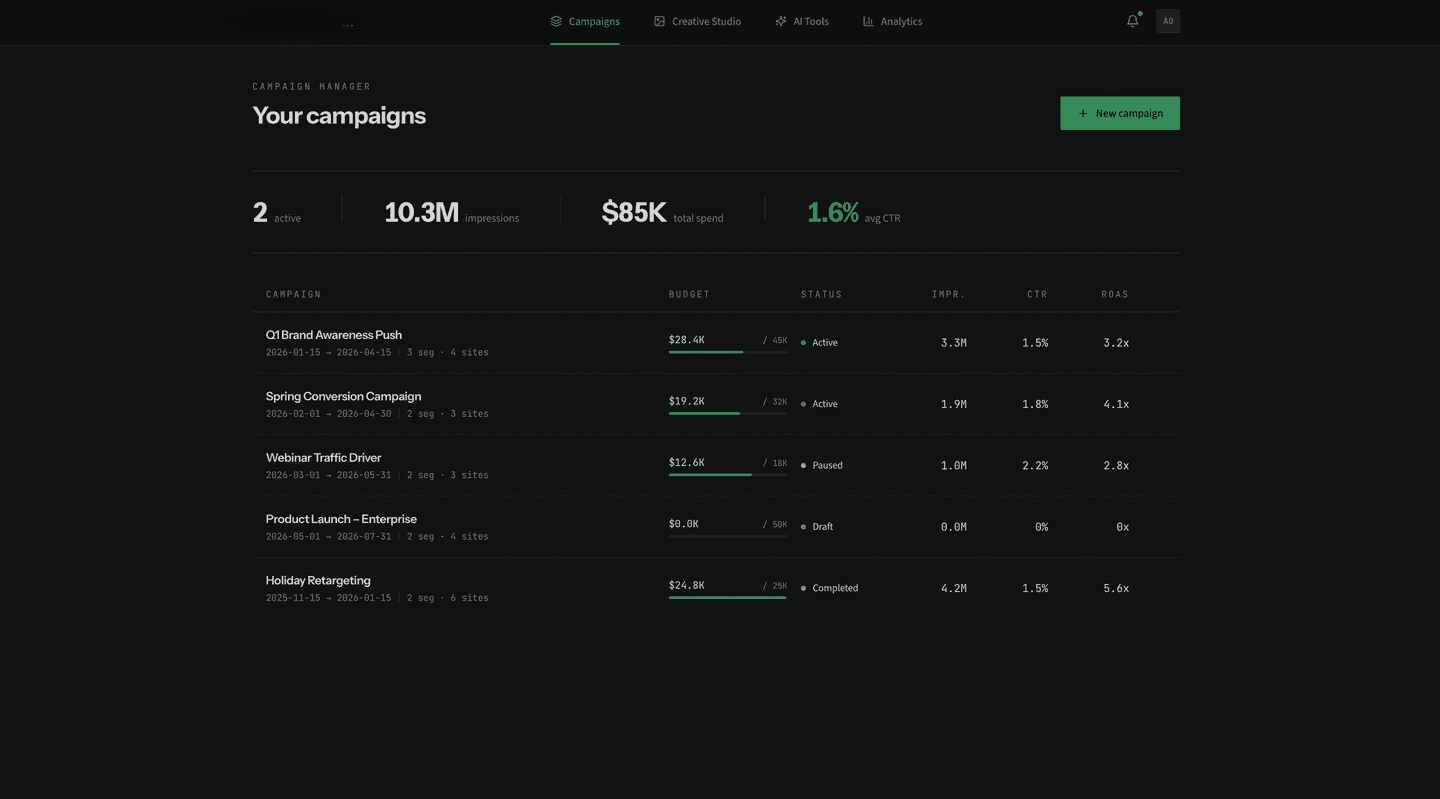
- Direct campaign creation for advertisers, including audience targeting, scheduling, budget management, and inventory selection, replacing the multi-day email-and-sales-rep workflow
- A built-in creative studio where advertisers upload assets, crop and resize for multiple ad formats, preview placements across the publisher network, and manage creative libraries without external design tools
- AI-powered copy generation — branded internally as "Magic Words" — that suggests headlines, body text, and calls-to-action based on campaign objectives, audience segments, and historical performance patterns
- AI dynamic campaign optimization that uses historical performance data pre-configured by publisher admins to automatically adjust bidding strategies, audience targeting weights, and creative rotation based on real-time signals and natural-language prompts
- A publisher admin console where ad operations teams configure AI optimization models, manage inventory allocation, set floor prices, define audience segments, and monitor platform health
- Integration with the existing ad server and billing system to maintain a single source of truth for delivery, revenue, and invoicing
Business challenge
Scaling advertiser relationships through a sales-only model created compounding operational strain as the client's publisher network grew. Key challenges included the following.
- Lost long-tail revenue from manual sales dependency: Smaller advertisers with budgets under $5 000 per month could not justify the overhead of working through sales reps. These advertisers either churned or never onboarded, leaving an estimated 25–35% of addressable demand untapped. Industry data indicates that self-serve platforms reduce minimum effective spend thresholds by 60–80%
- Slow campaign setup cycles: Campaign creation required an average of four to five business days from brief to live, involving back-and-forth between advertisers, account managers, and ad operations. During peak seasons, the queue grew longer, and advertisers missed time-sensitive windows
- Fragmented creative production: Advertisers produced creatives in external tools or relied on the client's design team for asset production. Format requirements varied across the publisher network, leading to rejected creatives, resubmissions, and delayed launches. Creative-related delays accounted for roughly 40% of total campaign setup time
- Manual optimization with limited data leverage: Ad operations adjusted targeting, pacing, and creative rotation based on periodic performance reviews rather than real-time signals. Historical data existed in the ad server but was not systematically applied to optimization decisions. Campaigns ran with static settings for days before adjustments were made
- Publisher admin overhead: Configuring inventory, setting floor prices, and managing audience segments required direct database queries or coordination with the engineering team. Ad operations lacked self-service tools for routine configuration tasks
Solution
Advantrix Labs partnered with the client to design and build a self-serve creative ad platform that combines campaign management, creative production, and AI-powered optimization in a single interface for advertisers, with a dedicated admin console for publisher operations.
- Self-serve campaign builder: Advertisers create campaigns through a guided workflow — selecting audience segments, choosing inventory placements, setting budgets and schedules, and defining objectives. The system validates configurations against available inventory and floor prices in real time. Campaigns move through a lightweight approval queue with auto-approval rules for trusted advertisers
- Built-in creative studio: A browser-based tool lets advertisers upload images, videos, and copy, then automatically generates format-compliant variations for all selected placements. Crop, resize, and preview tools show exactly how creatives appear on each publisher site. Creative libraries persist across campaigns with automatic format and quality validation
- AI Magic Words — dynamic copy generation: An AI-powered engine generates headline, body text, and call-to-action suggestions based on campaign objectives, audience segments, and historical click-through patterns. Advertisers accept, edit, or regenerate suggestions. Publisher admins pre-configure guardrails — brand-safety filters, prohibited terms, tone guidelines — that the AI respects automatically
- AI campaign optimizer: A dynamic optimization engine processes real-time delivery signals against historical performance data pre-configured by publisher admins. Advertisers express goals through natural-language prompts and the system continuously adjusts bidding strategies, targeting weights, and creative rotation. Publisher admins control optimization boundaries including maximum bid adjustments and pacing thresholds
- Publisher admin console: Ad operations teams manage inventory allocation, floor prices, audience segments, and AI configuration through a dedicated interface with real-time platform health monitoring, revenue dashboards, and advertiser activity feeds
- System integration layer: Bidirectional synchronisation with the existing ad server ensures delivery data, impression counts, and revenue figures remain consistent. Billing integration automates invoicing based on delivered impressions and agreed rates
Solution gallery
Product and workflow visuals from the delivered solution.
Business outcomes
By combining self-serve campaign management, integrated creative tools, and AI-powered optimization, Advantrix Labs delivered a platform that opened new revenue channels and dramatically reduced operational overhead for the client's publisher network.
- 40% increase in self-serve ad revenue: direct advertiser access eliminated the sales bottleneck for long-tail advertisers, capturing demand that was previously unreachable through manual workflows
- 3× faster campaign setup: guided workflows and automated creative formatting reduced average campaign launch time from four to five business days to under one day
- 25% higher CTR on AI-optimized campaigns: dynamic optimization driven by historical data and real-time signals consistently outperformed manually managed campaigns across the publisher network
- 60% reduction in creative production time: the built-in studio with automatic format generation and AI copy suggestions eliminated external tool dependencies and design team bottlenecks
- 70% reduction in publisher admin configuration time: self-service tools for inventory, pricing, and AI configuration replaced manual database queries and engineering requests