
Turning First-Party Data into a Revenue Product for a Mid-Market US Publisher
Ridgeline Media is a mid-market US digital publisher operating seven niche content sites across outdoor recreation, personal finance, and home improvement verticals, generating roughly $9 million in annual advertising revenue. In every direct sales conversation, the team led with "we have rich first-party data" — 220 000 registered users, detailed behavioral signals, deep contextual expertise. Buyers were interested. But when they asked "can I target your registered users who read personal finance content?" the answer was "not exactly." There was no segment builder, no clean targeting integration with the ad server, and no measurement proving the data actually worked. Industry research shows that addressable impressions fetch an average of $12.74 CPM compared with $3.78 for non-targeted inventory — a 3.4× gap (Digiseg/AdExchanger, 2025). Ridgeline had the audience to close that gap. They just needed a platform to productize it. Advantrix Labs partnered with the team to build a first-party audience intelligence layer — segment builder, ad server integration, and buyer-facing measurement — so the sales team could show up to every conversation with a data catalog instead of a talking point.
Project Snapshot
Client profile
Ridgeline Media is a mid-market US digital publisher with seven niche content sites serving audiences across outdoor recreation, personal finance, and home improvement verticals. The company generates approximately $9 million in annual advertising revenue from a mix of programmatic demand and direct-sold campaigns, with 40 employees including a sales team of eight and a two-person ad operations team. Ridgeline had invested years building a registered user base of 220 000 accounts with detailed preference profiles, behavioral signals, and contextual engagement data — but that data lived in a CRM and a basic analytics tool, completely disconnected from the ad server and invisible to buyers.
Project goal
Build a first-party audience intelligence platform that delivers the following.
- An audience segment builder that turns raw registration and behavioral data into 10–30 named, buyer-ready segments with live audience size estimates, organized by vertical interest, engagement level, and intent signals
- Full targeting integration with the ad server so campaigns can deliver against each segment in real time — turning a data promise into a trackable delivery
- A buyer-facing measurement dashboard where advertisers see segment performance versus run-of-site inventory during and after every campaign, giving them the proof they need to renew at premium rates
- An internal segment catalog where the ad ops team creates, edits, and publishes segments with pricing tiers without engineering involvement
- Sales-ready segment cards with live audience sizes, behavioral characteristics, and performance benchmarks that the sales team can share directly in proposals
Business challenge
Ridgeline's first-party data was the right asset in the wrong format. The sales team knew their audience better than any programmatic platform could — but buyers operate on proof, not promises.
- Data visible only internally, invisible to buyers: registration data, behavioral signals, and content affinity scores lived in isolated tools with no connection to the ad server. Buyers looking for audience targeting — finance enthusiasts, active renovation researchers, outdoor gear shoppers — went to publishers who could actually show them segments and delivery proof
- Deals closing at commodity CPMs: without data targeting, direct deals competed on reach alone. Research from Digiseg and AdExchanger shows addressable impressions average $12.74 CPM versus $3.78 for non-targeted inventory. Every direct deal without audience targeting left 60–70% of potential value on the table
- Sales conversations hitting a wall: when buyers pressed for specific targeting options, audience sizes, or performance benchmarks from previous campaigns, the answer was 'we'll check on that.' That friction cost deals and pushed buyers toward competitors with established data products
- No measurement to justify premium rates: even when buyers tried audience-targeted campaigns, there was no dedicated dashboard showing how those segments performed versus run-of-site. Without proof, buyers could not justify paying more — and renewal rates on direct deals suffered
- Ad ops rebuilding targeting from scratch every campaign: the two-person ops team set up GAM targeting by hand for each campaign with no segment library and no standardized definitions. Every campaign was rebuilt from memory. 85% of publishers expect first-party data to be their top revenue driver in 2026 (Digiday Research) — but without tooling, it stays a liability
Solution
Advantrix Labs partnered with Ridgeline to build a first-party audience intelligence platform that turns their registered user base and behavioral data into a structured, sellable product integrated directly into the delivery pipeline.
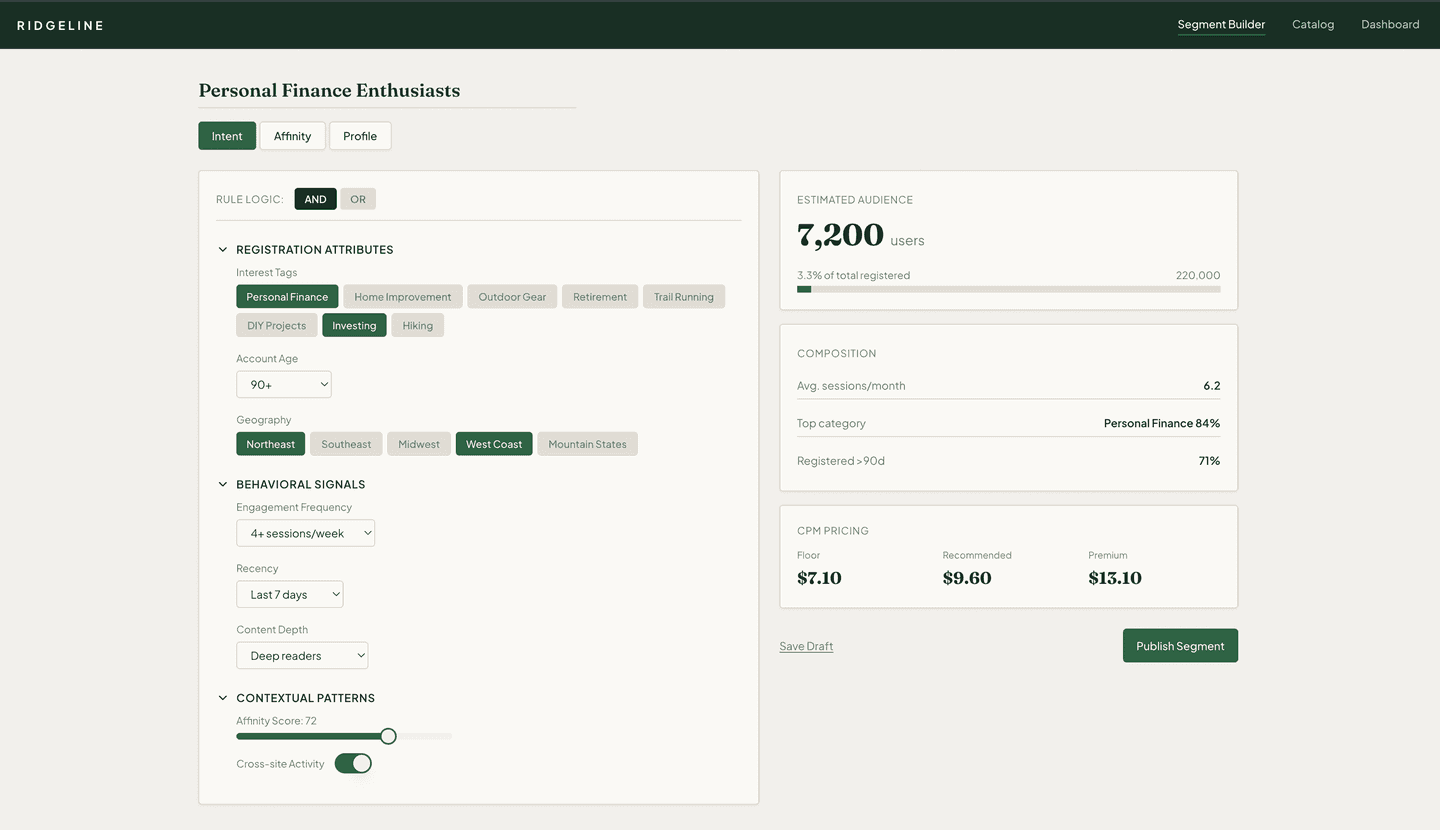
- Audience segment builder: a rule-based internal tool combining registration attributes, behavioral signals, and contextual engagement patterns. Three segment tiers — intent (high-frequency category researchers), affinity (consistent topic engagement), and profile (demographic and lifestyle attributes). Live audience size estimates update as rules are adjusted so the ops team knows what they're selling before publishing
- Ad server targeting integration: every published segment pushes directly into Google Ad Manager as a first-party audience list, ready for trafficking in seconds. Segment updates sync automatically. Delivery data flows back into the measurement layer, closing the loop between segment definition and live performance
- Buyer-facing measurement dashboard: advertisers see delivered impressions by segment, click-through rate, viewability, and CPM side by side with the run-of-site baseline — updated daily during campaigns and available as a post-campaign summary for renewal conversations
- Segment catalog and pricing tool: a structured library of all published segments with audience size, behavioral description, pricing tier, and historical performance benchmarks. The sales team shares segment cards directly from the catalog in proposals and RFPs
- Behavioral data pipeline: a lightweight tracking layer ingests page views, scroll depth, and content engagement signals from all seven sites, computing per-user category engagement scores nightly — feeding the segment builder with accurate, up-to-date signals
Solution gallery
Product and workflow visuals from the delivered solution.
Business outcomes
By building a proper audience product layer connected to the ad server, Advantrix Labs turned Ridgeline's first-party data from a sales talking point into a revenue-generating product.
- 40% CPM premium on addressable inventory: campaigns targeting Ridgeline audience segments consistently outperformed run-of-site baselines, giving buyers the performance proof they needed to pay more at renewal
- $420K in net-new annual revenue from existing traffic: 18 audience segments gave the sales team a product catalog where none existed before — new deals closed specifically against segment targeting without adding pageviews
- 18 sellable segments live within 12 weeks: the segment builder and ad server integration went from kickoff to production in under three months, with the sales team using live segment data in proposals before full platform launch
- Sales team closes conversations instead of losing them: segment cards with live audience sizes and performance benchmarks replaced "we'll check on that" with immediate, specific answers — deals closed faster, fewer lost to competitors
- 70% faster campaign setup: standardized segment definitions replaced per-campaign manual targeting recreation, freeing the ops team to handle more concurrent direct deals with the same headcount