
Building a Secure Accounts Management Platform for a Mid-Market FinTech Company
Imagine, a mid-market FinTech company, needed to replace a fragmented, legacy-dependent accounts management system with a modern, secure web application. The company serves consumers and small businesses that manage balances, execute transactions and monitor portfolio performance through a single digital interface. With digital banking adoption surpassing 75% of consumers globally and regulatory requirements tightening across jurisdictions, Imagine required a platform that could deliver real-time financial data, enforce bank-level security and comply with evolving financial regulations, all while improving the user experience enough to compete with larger, better-funded digital banking products.
Project Snapshot
Client profile
Imagine is a mid-market FinTech company that provides digital accounts management services to consumers and small businesses. The platform allows users to view balances, execute transactions, track spending and generate portfolio reports. Before engaging Advantrix Labs, the client relied on a legacy PHP monolith for core financial operations and a patchwork of internal tools for customer-facing workflows. As the user base grew, the system struggled with performance, and the outdated interface eroded trust among users accustomed to the polish of modern banking applications.
Project goal
Build a secure, modern accounts management web application with the following capabilities.
- A responsive, conversion-optimised interface that instils user confidence through clean financial data presentation and intuitive account workflows
- Complex financial data visualisation covering balances, transaction histories, spending categories and portfolio reporting, rendered with interactive charts and real-time updates
- Real-time data streaming via WebSocket connections, ensuring that account balances, transaction statuses and notifications update instantly without page refreshes
- A secure, dedicated financial processing service for transaction processing, ledger updates and cryptographic operations, preserving and modernising the client's existing domain logic
- API integration with banking APIs, payment gateways and regulatory compliance services, supporting KYC, AML and PCI DSS requirements
- Multi-factor authentication with bank-level session management to protect sensitive financial data
Business challenge
Imagine operated in a market where user trust is the primary currency. Any friction, latency or perceived insecurity in an accounts management platform directly impacts adoption and retention. Several structural issues constrained the business.
- Eroding user trust and low conversion: The legacy interface felt outdated compared to competitors. Research from Deloitte indicates that 38% of digital banking users will switch providers over poor UX, and the client's account creation funnel suffered from high abandonment rates. Users who began the sign-up process frequently dropped off before completing identity verification and funding their accounts
- Transaction processing latency: The monolithic PHP backend processed transactions synchronously, creating bottlenecks during peak hours. In financial services, latency is not merely an inconvenience; delayed balance updates and slow transaction confirmations erode user confidence. Studies show that 53% of users abandon a financial application if key actions take longer than three seconds to complete
- Regulatory compliance burden: Financial services platforms must satisfy KYC (Know Your Customer), AML (Anti-Money Laundering) and PCI DSS requirements. The existing system handled compliance checks through manual processes and ad-hoc integrations, increasing the risk of non-compliance and slowing account onboarding. As regulations tighten globally, a structured compliance layer was essential
- Fragmented legacy architecture: Core financial logic, including ledger management, transaction validation and cryptographic signing, resided in the PHP monolith. Rewriting this battle-tested domain logic from scratch would introduce risk and delay. The challenge was to modernise the platform while preserving the reliability of the existing financial processing layer
- No real-time data capabilities: Account balances and transaction statuses refreshed only when users manually reloaded the page. In an era where users expect instant feedback, this created a perception of unreliability. McKinsey research on digital banking emphasises that real-time capabilities are a baseline expectation for modern financial products, not a differentiator
- Limited financial insights: Users had access to basic transaction lists but no meaningful visualisation of their financial data. Without spending breakdowns, portfolio overviews or trend analysis, the platform failed to deliver the value that retains users long-term
Solution
Advantrix Labs partnered with Imagine to architect and deliver a modern accounts management platform that combines a high-performance frontend with a hybrid backend, preserving proven financial logic while introducing the speed, security and experience quality that modern FinTech demands.
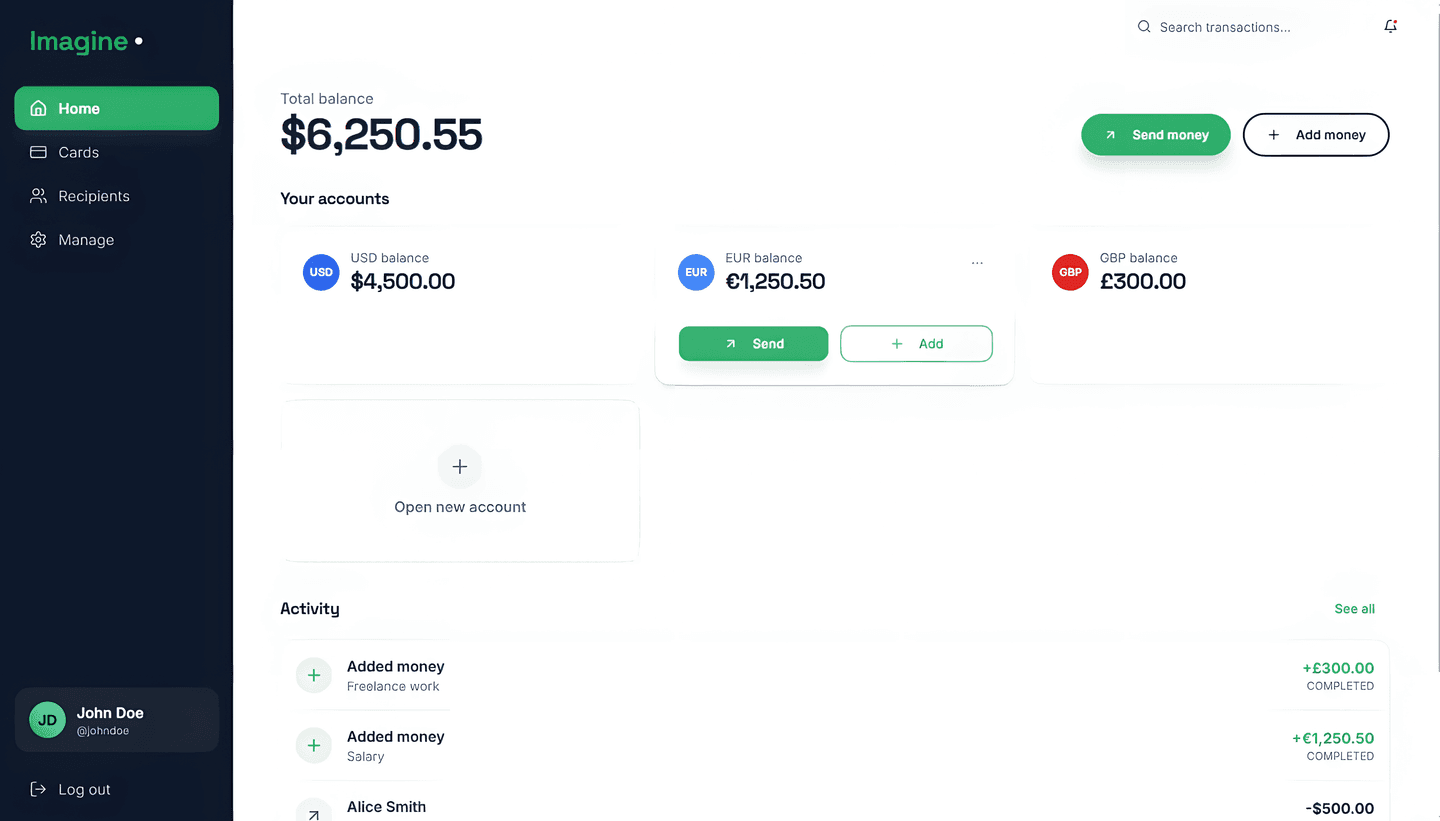
- Conversion-focused financial UI: We built a new frontend designed specifically for financial data presentation. Every screen was crafted to communicate trust and clarity, with consistent typography, restrained colour palettes and deliberate information hierarchy. Account dashboards present balances, recent activity and alerts in a layout that reduces cognitive load. The sign-up and account creation flow was streamlined to minimise steps while maintaining compliance checkpoints, guiding users from registration through identity verification to account funding in a single, coherent journey
- Complex financial data visualisation: Interactive charts and graphs present balance histories, spending categories, income versus expenditure, and portfolio allocation. Users can filter transactions by date range, category, account and status. Drill-down views allow users to move from summary-level overviews to individual transaction details. The visualisation layer uses server-side rendering for initial loads and client-side hydration for interactive exploration, balancing performance with richness
- Real-time transaction streaming: WebSocket connections deliver live updates for account balances, transaction confirmations, payment statuses and system notifications. When a user initiates a transfer or receives a payment, the interface reflects the change immediately without requiring a page refresh. This real-time feedback loop reinforces trust and gives users confidence that their financial data is current and accurate
- Secure PHP microservice for financial operations: Rather than discarding the client's existing PHP financial logic, Advantrix Labs extracted and re-architected it into a dedicated financial processing microservice. This service handles transaction validation, ledger updates, double-entry bookkeeping, cryptographic signing of financial records and secure communication with external banking systems. Isolating this logic in its own service provided clear security boundaries, independent scaling and the ability to apply targeted hardening without affecting the rest of the platform
- Hybrid Node.js and PHP backend: The application layer manages API routing, authentication flows, real-time connections, session management and orchestration of external service calls. The financial processing microservice handles the transaction processing layer. This hybrid architecture allows each layer to operate where it performs best: the application layer for high-concurrency I/O and real-time communication, the financial service for established domain logic and cryptographic operations
- Banking API and payment gateway integration: The platform integrates with banking APIs for account verification, balance retrieval and payment initiation, as well as payment gateways for card processing and fund transfers. An abstraction layer normalises responses from different providers, making it straightforward to add new banking partners or payment methods without modifying core application logic
- Compliance and security infrastructure: Multi-factor authentication protects user accounts. Session management enforces automatic timeouts, device fingerprinting and anomaly detection. KYC and AML checks are integrated into the onboarding flow via third-party compliance APIs, automating identity verification and risk screening. All financial data is encrypted at rest and in transit, and the PHP microservice applies cryptographic signatures to ledger entries for audit integrity
Solution gallery
Product and workflow visuals from the delivered solution.
Business outcomes
By delivering a modern, secure accounts management platform that preserved proven financial logic while introducing a premium user experience and real-time capabilities, Advantrix Labs helped Imagine compete effectively in a market where trust, speed and compliance determine success.
- 42% increase in account creation conversions: The streamlined onboarding flow, modern interface and integrated compliance checks reduced friction in the sign-up funnel. Users who previously abandoned during identity verification now complete the process at significantly higher rates, directly expanding the client's active user base
- 55% reduction in transaction processing latency: The dedicated financial processing microservice, optimised for financial operations and decoupled from the monolithic architecture, processes transactions faster and more reliably. Combined with application-layer orchestration and real-time data delivery, users experience near-instant transaction confirmations, reinforcing trust in the platform
- 48% improvement in user retention: Real-time data streaming, interactive financial visualisations and a polished, trust-oriented interface increased the perceived value of the platform. Users engage more frequently with spending insights and portfolio views, strengthening the habit loop that drives retention. Research from Bain & Company shows that a 5% increase in customer retention in financial services can increase profits by 25-95%, making this improvement commercially significant
- Regulatory compliance without friction: Automated KYC, AML and PCI DSS workflows reduced the compliance burden on the operations team while accelerating user onboarding. The structured compliance layer positions the client to adapt to new regulatory requirements without re-engineering the platform
- Preserved and modernised legacy investment: By extracting the PHP financial logic into a secure microservice rather than rewriting it, the client preserved years of battle-tested domain knowledge while gaining the benefits of a modern, independently scalable architecture. This approach reduced delivery risk and allowed the team to ship the new platform faster than a full-stack rewrite would have permitted