Centralizing Vendor and Procurement Operations for a Growing eCommerce Brand
Meridian is a mid-market B2C eCommerce company selling across its own storefront and marketplace channels. As the business scaled past $15 million in annual revenue and expanded its supplier base to over 200 vendors across multiple countries, the procurement team hit a wall. Purchase orders lived in spreadsheets, vendor onboarding happened over email, landed-cost calculations were manual, and supplier communication was scattered across inboxes. Industry research shows that companies with fragmented procurement processes experience 20–30 % higher carrying costs and 2–3× longer supplier onboarding cycles compared with those using centralized procurement platforms. Meridian partnered with Advantrix Labs to build a single operations platform that would bring vendor management, purchasing, cost tracking, and supplier communication under one roof.
Project Snapshot
Client profile
Meridian is a mid-market B2C eCommerce brand selling home, lifestyle, and seasonal products through its own storefront and third-party marketplaces. The company sources from over 200 vendors across domestic and international suppliers. Revenue had grown past the $15 million mark, but the procurement and operations team — roughly 25 people across purchasing, finance, and warehouse — still relied on spreadsheets, email, and disconnected tools for day-to-day vendor management and purchasing. This created bottlenecks as the catalogue expanded and supplier relationships became more complex.
Project goal
Build a centralized vendor and procurement operations platform that delivers the following.
- Provides a self-service vendor onboarding portal that collects company details, compliance documents, tax forms, and product catalogues through a structured workflow, replacing the weeks-long email-based process that delayed new product launches
- Automates purchase order creation with configurable reorder triggers based on inventory thresholds, reducing manual monitoring and stock-out risk. Research from the Institute for Supply Management shows that automated reorder systems can reduce stock-out frequency by 30–50 %
- Calculates real-time landed costs per product and per supplier, factoring in unit cost, freight, duties, insurance, and currency fluctuations, giving finance teams accurate margin visibility without manual spreadsheet reconciliation
- Centralizes supplier communication in contextual threads tied to specific purchase orders and shipments, eliminating scattered email chains and reducing response-time ambiguity
- Delivers role-based dashboards for procurement managers, finance analysts, and warehouse coordinators, each surfacing the data and actions relevant to their workflows
- Integrates with the client's existing commerce platform, warehouse management system, and accounting software to maintain consistent data across systems
Business challenge
Managing a growing supplier base and increasing purchase volume with manual tools created compounding operational risk. As Meridian's catalogue expanded and vendor count grew, the gaps in their procurement process widened. Key challenges included the following.
- Frequent stock-outs from reactive purchasing: Without automated reorder triggers, procurement managers monitored inventory levels manually across spreadsheets. Seasonal demand spikes and supplier lead-time variability meant stock-outs happened regularly, costing the business an estimated 8–12 % of potential monthly revenue during peak periods. Industry data indicates that stock-outs cause an average 4 % revenue loss per incident for eCommerce brands
- Slow vendor onboarding: Bringing a new vendor into the system required multiple email exchanges to collect tax documents, compliance certifications, bank details, and product catalogues. The average onboarding cycle took three to four weeks, delaying new product listings and seasonal assortment changes
- No visibility into true product margins: Landed-cost calculations were done manually in spreadsheets and often lagged behind actual costs. Currency fluctuations, varying freight charges, and duty rate changes meant the margin figures finance reviewed were frequently inaccurate. Decisions about pricing, promotions, and vendor negotiations relied on stale data
- Scattered supplier communication: Purchase order discussions, shipment updates, dispute resolution, and general vendor communication happened across personal email inboxes. When a team member was out, context was lost. There was no centralised record of what was agreed, what was shipped, or what was disputed
- Disconnected systems: The commerce platform, warehouse management system, and accounting software each held a piece of the procurement picture but did not communicate with each other in real time. Inventory counts, cost-of-goods data, and payment status had to be reconciled manually, creating delays and errors
Solution
Advantrix Labs partnered with Meridian to design and build a centralized procurement operations platform that consolidates vendor management, purchasing, cost tracking, and supplier communication. The platform integrates with the client's existing systems and provides tailored interfaces for each operational role.
- Vendor onboarding portal: New vendors receive an invitation link and complete a structured, multi-step form covering company details, banking information, tax documents, compliance certifications, and product catalogues. The system validates submissions in real time, flags incomplete or expired documents, and routes applications through an internal approval chain. Approved vendors are provisioned automatically with their negotiated terms and price lists. The entire onboarding history is auditable with timestamps, approver identities, and document versions
- Automated purchase order engine: Procurement managers configure reorder rules per SKU or category, and the system generates draft purchase orders when stock levels approach thresholds. Each draft pre-populates supplier details, negotiated costs, lead times, and shipping terms. Managers review, adjust, and approve with a single action. The system tracks every PO through its full lifecycle with automated reminders and escalation rules for overdue stages
- Landed-cost tracker: Aggregates data from purchase orders, shipment records, and daily exchange rates to calculate real-time product-level landed costs. Finance teams see unit cost, freight, duties, insurance, and warehousing charges rolled into a single cost-of-goods figure. Automated alerts flag products where margins drop below configurable thresholds
- Supplier communication hub: Contextual, threaded conversations tied to specific purchase orders, shipments, or disputes replace scattered email. Internal team members can add private notes, tag colleagues, and escalate threads. Message delivery and read status update in real time, giving procurement teams visibility into supplier responsiveness
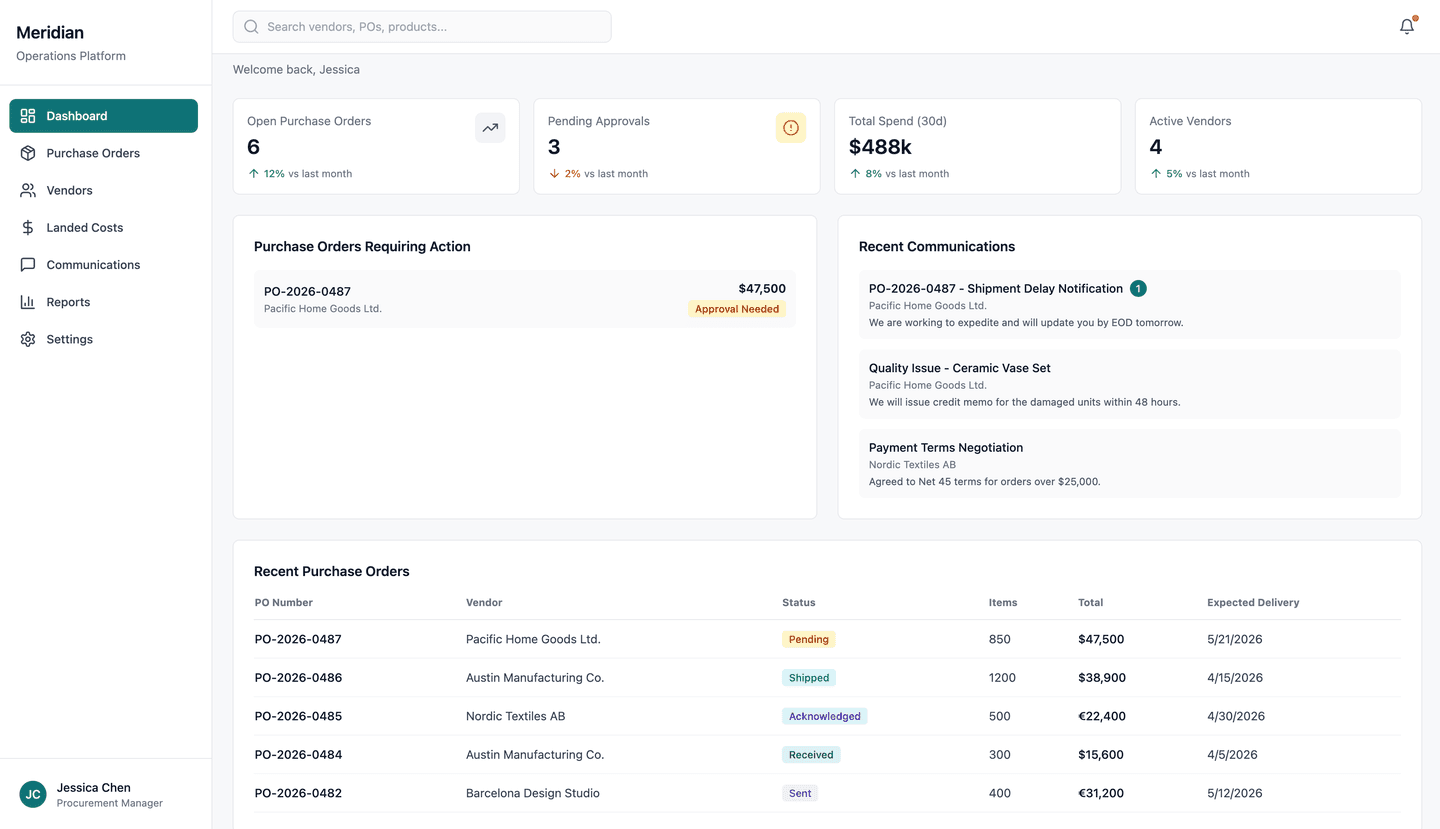
- Role-based dashboards: Procurement managers see open POs, pending approvals, and reorder alerts. Finance sees margin trends, cost breakdowns, and payment status. Warehouse coordinators see inbound shipment schedules and receiving queues. Each view surfaces only the data and actions relevant to that role
- System integration layer: Bidirectional data synchronisation with the commerce platform, warehouse management system, and accounting software ensures inventory counts, cost-of-goods, and payment status remain consistent across all systems without manual reconciliation
Solution gallery
Product and workflow visuals from the delivered solution.
Business outcomes
By centralizing vendor and procurement operations, Advantrix Labs delivered a platform that replaced fragmented manual workflows with structured, auditable processes. The result is faster purchasing cycles, accurate cost visibility, and operational confidence as the business continues to scale.
- 45 % reduction in stock-outs: automated reorder triggers and real-time inventory threshold monitoring caught replenishment needs before they became stock-outs, recovering revenue that was previously lost during peak demand periods
- Vendor onboarding cut from weeks to days: the self-service portal with structured workflows and automated document validation reduced average onboarding time from 3–4 weeks to 3–5 business days, enabling faster catalogue expansion
- 3× faster procurement cycle: automated PO generation, single-click approvals, and status tracking across the full purchase order lifecycle eliminated manual coordination that previously bottlenecked every order
- 20 % improvement in gross margin accuracy: real-time landed-cost calculations with daily exchange rates replaced stale spreadsheet estimates, giving finance teams reliable margin data for pricing and promotion decisions
- 15+ hours per week returned to strategic work: procurement and finance teams shifted from manual data entry, email chasing, and spreadsheet reconciliation to supplier negotiation, assortment planning, and cost optimisation