
AI-Powered Search and Discovery for a D2C Home Goods Brand
Vela is a US-based D2C brand selling premium home textiles and natural-fiber goods. As their catalog grew past 3,000 SKUs, Shopify's keyword-only search started failing customers. Research shows 63% of zero-results queries are natural language phrases — 'soft winter gift for her', 'cozy throw' — that keyword engines simply cannot match (Zoovu, 2025). At the same time, 69% of online shoppers say search is the primary way they find products (HelloRetail, 2026), so dead-end search pages directly cost the brand revenue every day. On top of that, every homepage banner, seasonal campaign, or collection update required a dev ticket and a 3–5 day wait. Vela needed a storefront that understood what customers were actually looking for, and a content setup the marketing team could run without waiting on engineering.
Project Snapshot
Client profile
Vela is a US-based D2C brand selling premium home textiles, natural-fiber goods, and handcrafted ceramics. The brand sells direct only — no retail, no wholesale. With 3,000+ SKUs across multiple material categories and seasonal drops, their audience shops with lifestyle intent. A customer searching "soft winter gift for her" is looking for a merino throw, not a product called "Merino Throw 130x180 Natural." Shopify's default search did not bridge that gap.
Project goal
Build an AI-native discovery experience on a headless Shopify storefront — closing the gap between how customers search and how products are catalogued, while giving the marketing team direct control over content without dev dependency.
- Replace keyword-only search with AI semantic search that understands natural language and lifestyle intent
- Surface personalized recommendations based on browsing behavior, purchase history, and product affinity
- Connect a headless CMS so marketing can publish seasonal campaigns, banners, and collection features same day
- Rebuild the storefront on a headless architecture for fast load times, full SEO control, and scalability beyond Shopify theme limits
- Automate collection merchandising: auto-sort by trend signals, inventory velocity, and margin rules
Business challenge
Shopify's default search and theme worked when Vela launched. At scale, both became growth ceilings.
- Keyword search cut off 28% of queries: shoppers used natural language like "soft winter gift for her" that Shopify's engine treated as a literal phrase match — returning zero results or irrelevant products. Research confirms 63% of zero-results queries are exactly this kind of descriptive language that keyword engines cannot process (Zoovu, 2025). Each dead end was a lost sale
- Search was the primary revenue channel — and it was broken: 69% of online shoppers say search is the most common way they find products (HelloRetail, 2026). Search users convert 3–5x more than average browsers (ExpertRec, 2025). Vela had no data to see how many high-intent visitors it was losing every day
- No personalization across a 3,000+ SKU catalog: every shopper saw the same products in the same order regardless of history, season, or browsing pattern. McKinsey research shows personalization can drive up to 15% revenue uplift for eCommerce businesses — Vela was capturing none of it
- Content locked behind dev tickets: the marketing team waited 3–5 business days for each homepage update, banner swap, or seasonal collection change. Campaign launches slipped because dev capacity was the bottleneck, not creative readiness
- Slow storefront holding back SEO and conversion: the Shopify theme loaded slowly on mobile, hurting Core Web Vitals scores and suppressing organic rankings for high-intent product queries
Solution
Advantrix Labs rebuilt Vela's storefront as a headless commerce platform — keeping Shopify as the commerce backend while replacing the frontend with a performance-first, AI-connected discovery experience.
- Headless Shopify storefront: A server-rendered storefront connected to the Shopify Storefront and Admin APIs, replacing the theme layer with a fast, SEO-clean frontend. LCP under 2.5s, structured URLs, full control over the shopping experience without theme constraints
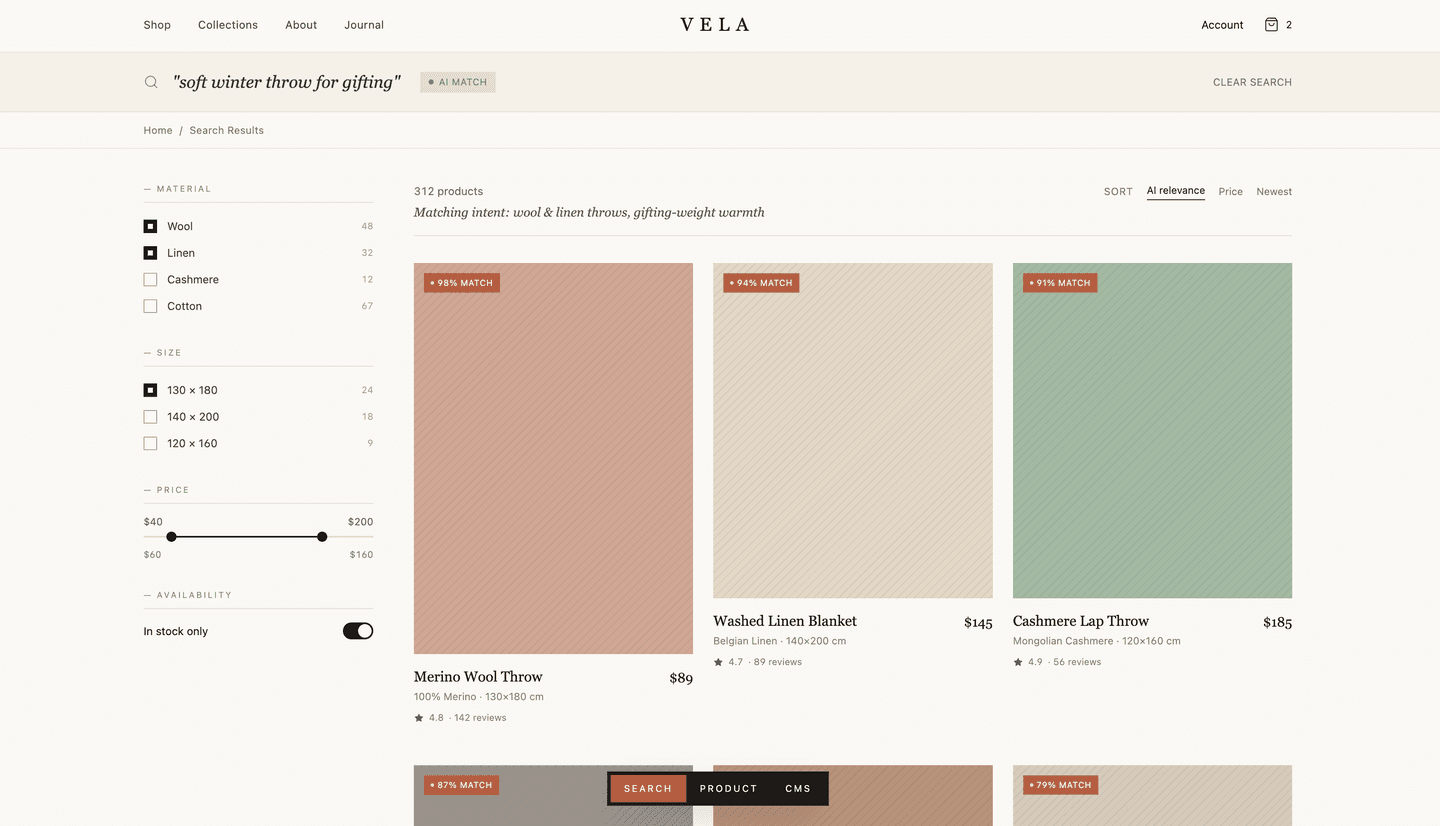
- AI semantic search with vector embeddings: Customer queries are matched against the full product catalog using vector similarity — understanding "cozy throw for winter gifting" and surfacing merino blankets, linen blankets, and cashmere blends ranked by relevance and intent, not keyword overlap. No-results rate dropped from 28% to under 6%
- Personalized recommendation engine: Browsing signals, purchase history, and product affinity scores feed a recommendation layer that updates per session. Cross-sell panels, "complete the set" suggestions, and recently-viewed products are driven by individual behavior, not static manual rules
- Self-serve content layer with headless CMS: A connected CMS gives the marketing team direct control over homepage heroes, featured collections, editorial blocks, and seasonal campaigns. Updates go live same day with visual preview before publishing — no dev ticket, no wait
- AI-powered collection merchandising: Collection sort order is managed automatically by trend signals, inventory velocity, and margin rules the team configures. Editors can apply manual boosts for launches or promotions without breaking the underlying ranking logic
- Search analytics and discovery reporting: A reporting layer captures query volume, no-results rate, click-through by position, and conversion by intent — giving the team data to close catalog gaps and improve content coverage over time
Solution gallery
Product and workflow visuals from the delivered solution.
Business outcomes
By replacing Shopify's native search and theme layer with an AI-powered headless storefront, Advantrix Labs gave Vela a discovery experience that matched how their customers actually shop.
- 35% lift in search-to-purchase conversion: semantic search closed the intent gap, turning shoppers who previously hit dead ends into buyers
- 18% increase in revenue per session: personalized recommendations drove cross-category discovery and lifted average order value beyond what static product grids could reach
- No-results search rate down from 28% to under 6%: vector search eliminated the dead ends that cost the brand sales every day
- Marketing team went from 3–5 day dev wait to same-day publishing: the self-serve CMS gave content editors direct control over campaigns and seasonal drops without engineering involvement
- Storefront LCP improved from 4.8s to 2.1s: headless architecture and edge delivery lifted Core Web Vitals and supported organic traffic growth through better search rankings
- AI merchandising cut manual collection sort work by ~80%: editors now set rules and exceptions instead of manually ranking hundreds of SKUs per collection