
Building a Custom Backoffice Platform for an Established eCommerce Storefront
Our NDA client is a mid-market US B2C eCommerce brand operating a custom-built storefront that had grown to $10 million in annual revenue with a catalog of over 8 000 SKUs. While the storefront delivered a strong customer experience, the team behind it was struggling. There was no unified admin panel — order management happened through a mix of database queries and basic internal tools, inventory was tracked in spreadsheets synced manually with the warehouse, and product updates required engineering involvement. Customer support had no single view of a buyer's history, and business metrics were assembled weekly in slide decks. Industry research shows that eCommerce brands with centralized operations platforms reduce order-to-ship time by 30–50% and cut data entry errors by 40–60% compared with fragmented manual workflows. The client partnered with Advantrix Labs to build a purpose-built backoffice that would connect to the existing storefront via API and bring every operational function under one roof.
Project Snapshot
Client profile
Our NDA client is a mid-market US B2C eCommerce brand selling consumer goods through a custom-built storefront. The business had grown to approximately $10 million in annual revenue with a catalog of over 8 000 SKUs, processing 3 000–5 000 orders per month. The operations team of roughly 20 people — spanning fulfillment, customer support, merchandising, and marketing — managed day-to-day operations through a mix of direct database access, spreadsheets, email, and disconnected third-party tools.
Project goal
Build a custom backoffice operations platform connected to the existing storefront via API that delivers the following.
- A centralized order management interface where the fulfillment team can view, search, filter, and process orders through their full lifecycle with batch actions, status tracking, and automated customer notifications
- Real-time inventory tracking synced with the storefront and warehouse, with low-stock alerts, bulk adjustment tools, and a full audit trail of every stock movement
- A product catalog manager that lets the merchandising team create and edit products, variants, pricing, images, and categories with bulk import/export and scheduled publishing, removing the dependency on engineering
- A unified customer view aggregating order history, communication log, lifetime value, and support tickets into a single profile for faster support resolution
- Real-time analytics dashboards covering revenue, orders, conversion, average order value, top products, inventory turnover, and customer acquisition
- Staff management with role-based access control, activity logging, and configurable permissions
- Returns and refunds management through structured workflows with approval steps, automated restocking, and payment gateway integration
- A discount and promotion engine for coupon codes, percentage and fixed-amount discounts, free shipping rules, and bundle offers
Business challenge
Running a growing eCommerce operation without a unified backoffice created friction at every step. As order volume and catalog size increased, the gaps became more expensive.
- Slow and error-prone order processing: The fulfillment team processed orders by querying the database directly and updating status through a basic internal tool that lacked search, filtering, or batch operations. Mistakes in order status, shipping address, or item quantities were caught only when customers complained
- No real-time inventory visibility: Inventory was tracked in spreadsheets updated manually once or twice a day. Between updates, the storefront could oversell items, leading to cancellations and refunds. An estimated 3–5% of orders per month were affected by inventory discrepancies
- Engineering bottleneck for catalog changes: Adding products, updating prices, or managing categories required a developer. Routine merchandising tasks that should take minutes took days, slowing seasonal launches and promotional campaigns
- Fragmented customer data: Customer information was spread across the storefront database, email marketing tool, support ticket system, and payment gateway. Support agents had to check multiple systems to understand a customer's history
- Manual reporting and blind spots: Business metrics were assembled manually into weekly reports. By the time leadership reviewed the numbers, the data was days old with no way to spot trends or react to changes in real time
- No access control or audit trail: Internal tools had minimal permissions with no log of who changed what, making it impossible to trace errors or enforce operational accountability
Solution
Advantrix Labs partnered with the client to design and build a custom backoffice platform that connects to the existing storefront through a dedicated API layer, providing every operational team with the tools and visibility they need.
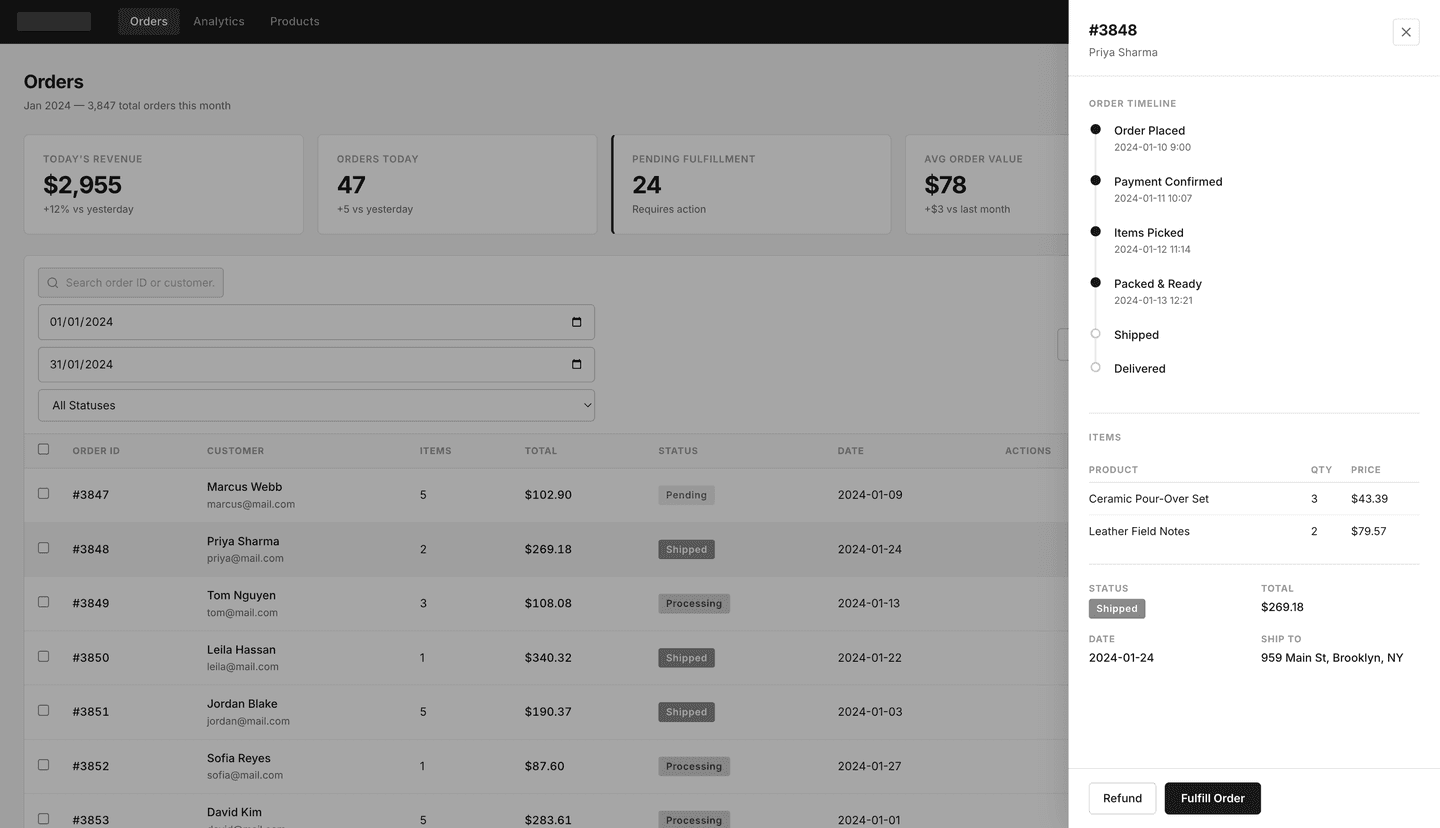
- Order management hub: A unified dashboard with full-text search, filtering, and saved views lets the fulfillment team manage orders efficiently. Batch actions update status, print labels, and trigger notifications for dozens of orders at once. Automated rules flag high-value orders and escalate shipments that miss SLA windows
- Real-time inventory system: Bidirectional sync with the storefront and warehouse logs every stock movement with timestamp, user, and reason. Low-stock alerts notify the team before problems reach customers, and availability updates propagate to the storefront within seconds
- Product catalog manager: The merchandising team creates and edits products, variants, pricing, images, and categories through a rich interface. Bulk import handles large updates, and scheduled publishing lets the team prepare collections and launch them at a specific date and time
- Unified customer profiles: A single view aggregates order history, lifetime spend, communication log, and support tickets. Customer segments feed into marketing workflows and loyalty initiatives
- Real-time analytics dashboards: Revenue, conversion, average order value, top products, inventory turnover, and return rates update in real time with trend lines and period comparisons. The marketing team tracks promotion performance live
- Returns and refunds workflow: Return requests surface in a dedicated queue with review, approval, label generation, and refund processing connected to the payment gateway. Approved returns automatically restock inventory
- Discount and promotion engine: The marketing team creates coupon codes, discounts, free shipping rules, and bundle offers with configurable rules, usage limits, and date ranges. Active promotions sync to the storefront and analytics tracks redemption impact
Solution gallery
Product and workflow visuals from the delivered solution.
Business outcomes
By building a purpose-built backoffice connected to the existing storefront, Advantrix Labs gave the operations team a single platform that replaced fragmented tools and manual processes with structured, real-time workflows.
- 60% reduction in order processing time: unified order management with batch actions and automated status updates eliminated database queries and manual coordination
- 40% fewer fulfillment errors: real-time inventory sync and structured order workflows caught discrepancies before they reached customers, reducing cancellations and wrong-item shipments
- Real-time inventory accuracy: bidirectional sync replaced daily spreadsheet updates, eliminating the 3–5% monthly oversell rate
- 70% faster catalog updates: the product manager interface removed the engineering bottleneck for routine merchandising tasks, cutting product launch preparation from days to hours
- 50% faster customer support resolution: unified customer profiles gave agents instant context, eliminating the need to check multiple systems
- From weekly to real-time reporting: live analytics dashboards replaced manually assembled reports, giving leadership immediate visibility into business performance