
Centralizing Pricing Management for a Fortune 50 Media & Ad‑Tech Leader
Our Fortune 50 media and entertainment client, whose streaming portfolio includes Hulu, Disney Plus, ESPN and more, needed to modernize internal pricing operations. As advertising inventory grew across multiple publishers and products, pricing administrators relied on spreadsheets and disparate tools to manage rate cards, pricing rules and advertiser associations. With pricing dependent on date ranges, targeting options and publisher‑specific rules—plus special cases for political and pre‑emptible inventory—manual workflows led to inconsistent pricing and operational risk. Industry research shows that decentralized pricing decisions can result in unwarranted discounts, inconsistent invoicing and limited visibility across data sources, while automated pricing processes reduce errors and free up teams to focus on strategic initiatives.
Project Snapshot
Client profile
The client operates one of the world’s largest streaming and media networks. Advertisers buy campaigns across Hulu, Disney Plus and Disney Streaming Entertainment (DSE). Pricing analysts must create and maintain hundreds of rate cards—covering standard, political and pre‑emptible inventory—while associating advertisers and groups to the correct pricing rules and publisher policies.
Project goal
Build a centralized pricing management platform that consolidates all rate cards, pricing rules and advertiser associations across publishers. The system should replace manual spreadsheets with a self‑service interface for internal pricing analysts, enable versioned revisions and audit trails, enforce role‑based permissions, and integrate seamlessly with the client’s existing ad server and customer management services.
Business challenge
Pricing in digital advertising depends on many dimensions: time ranges, audience targeting options, publisher‑specific rules and political or pre‑emptible cases. Without a single source of truth, internal teams risked inconsistent pricing and errors. Key challenges included the following.
- Fragmented data & manual workflows: Rate cards and pricing rules were stored in multiple spreadsheets and tools, leading to inconsistent pricing decisions and limited visibility. Industry experts note that decentralized pricing policies can lead to unwarranted discounts, misaligned pricing and limited ability to aggregate data
- Complex rule dependencies: Targeting options such as demographics, location, genres, platforms and audiences affected CPM. Political and pre‑emptible inventory required special validation. Manual rule ordering and sequencing increased the risk of errors
- Lack of auditability and governance: Without version control and change logs, analysts could not trace revisions or guarantee compliance. Dynamic pricing research emphasizes that systems with built‑in audit trails improve transparency and compliance and foster trust
- Slow updates and limited integration: Updating pricing across publishers required multiple steps, delaying campaigns and increasing workload. Pricing analysts needed a single interface with role‑based permissions and integrations with other services
Solution
Advantrix Labs partnered with the client to design and implement a pricing management platform that centralizes rate cards, pricing rules and advertiser associations. The platform is composed of three services integrated into the client’s existing ad‑tech infrastructure. This architecture centralizes pricing logic and provides consistent reporting and approval workflows. By exposing algorithms and rules through intuitive tools, the platform ensures that everyone in the organization makes profitable decisions. Data management delivers consistent reporting and clearly answers critical questions, while defined roles and processes uphold pricing goals and improve governance.
- Core pricing service: Stores rate cards, pricing rules and advertiser/group associations in a centralized system. Provides secure interfaces for creating, cloning, versioning and deleting rate cards; managing groups and marketers; and calculating total CPM by applying targeting adjustments and publisher‑specific rules. Change logs maintain user, time and version metadata for every revision
- Unified data layer: Normalizes pricing and customer data into a single query interface with pagination, filtering and sorting. Enforces authentication, role‑based permissions and request tracing across all operations
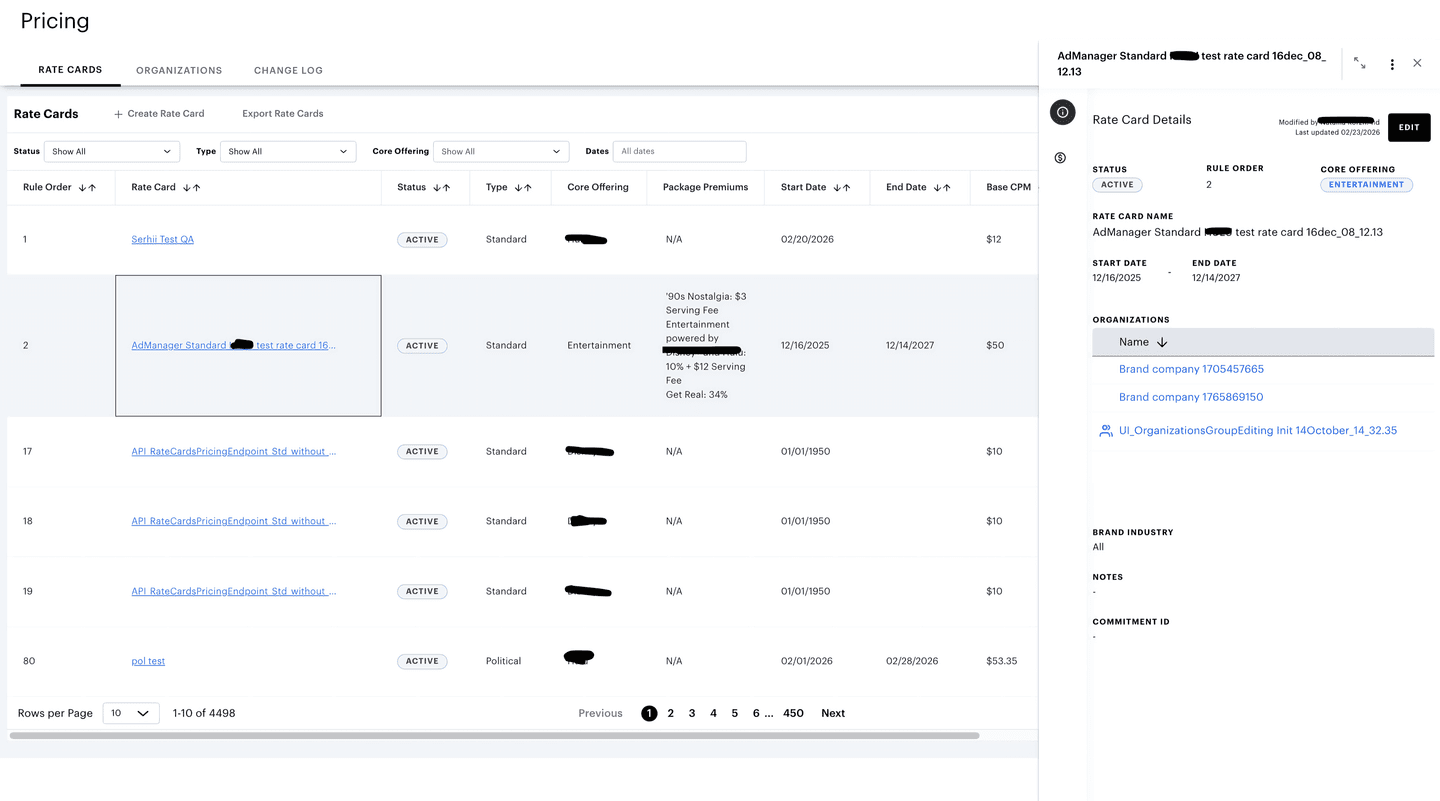
- Operations interface: Integrates into the client’s internal admin console. Pricing analysts can create, edit or clone rate cards; manage advertisers and groups; view applicable pricing by publisher; and explore a searchable change log. Filters allow users to sort by status, type, publisher and date. Permission‑aware actions and real‑time validation ensure safe updates
Solution gallery
Product and workflow visuals from the delivered solution.
Business outcomes
By centralizing pricing management, Advantrix Labs delivered a secure, scalable platform that replaces manual spreadsheets with automated tools and consistent workflows. The result is faster pricing updates, improved transparency and governance, and empowered analysts who can focus on strategic initiatives rather than administrative tasks.
- 60 % reduction in pricing update cycle time: automating rule management and consolidating data eliminated error‑prone spreadsheets, cutting the update process from days to hours
- Zero pricing inconsistencies across publishers: a central source of truth with versioned revisions and built‑in audit trails ensures every rate card follows the same rules and approval workflows
- 80 % fewer manual touch points per rate card: consolidated views and searchable change logs replaced fragmented spreadsheets, giving analysts instant access to any rate card, revision or advertiser association
- 15+ analyst hours per week redirected to strategy: with intuitive self‑service workflows and role‑based permissions, pricing teams shifted focus from data entry and reconciliation to pricing strategy and client relationships
- Faster compliance audit response: any rate card revision or historical pricing decision can be retrieved in seconds via searchable change logs, cutting audit preparation from days to hours